
The RBI's decision to tighten norms for unsecured personal loans is credit positive because lenders will need to allocate higher capital for such loans, thus improving their loss-absorbing buffers, Moody's Investors Service said on Monday. The Reserve Bank last week raised risk weights on unsecured retail loans, credit cards and lending to non-banking finance companies (NBFCs) by 25 percentage points. Moody's said unsecured loans have been growing rapidly in the past few years, exposing financial institutions to a potential spike in credit costs in case of sudden economic or interest rate shocks.

'FDs should hold your emergency funds, equivalent to around 6-12 times your monthly expenses.'

The protocol aims to "democratise" lending, reduce costs of credit, and ensure accessibility of credit to small companies and street vendors, according to Nandan Nilekani.

'There is still scope for selective stockpicking.'

'The shadow banks are currently facing a liquidity and solvency crisis.' 'The danger is that it could potentially engulf the entire financial system because shadow banks have borrowed huge amount of money from banks, mutual funds, pension funds, and insurance companies.'

The legislation is being implemented by the Corporate Affairs Ministry. Many provisions of the new law came into effect from April 1.

Companies don't have to be in the field to nudge people to return money they owe lenders.

'Das is friendly, but he finally does what he does. The quality of engagement is very good.'
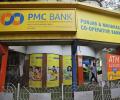
the three investors that have submitted their final bids are not commercial banks. Among the three, one is a non-banking financial company. Another distinctive feature of the revival is that PMC may lose its cooperative bank characteristic after its reconstruction.

If the policy is extended to NBFCs and co-operative banks, they will have to disclose divergence in asset classification and provisioning during RBI inspections in their audited financial reports. Till now, these entities have been exempted from this. At present, there are more than 98,000 co-operative banks and 10,000 NBFCs. Sources said the RBI would concentrate on the top 50 co-operative banks and NBFCs.

S&P Global Ratings on Monday expressed scepticism over allowing corporate ownership in banks given India's weak corporate governance amid large corporate defaults over the past few years. It also said that the Reserve Bank of India (RBI) will face challenges in supervising non-financial sector entities at a time when the health of financial sector is weak. Last week, a RBI panel had proposed that large corporate may be permitted to promote banks, as well as raising the cap on promoters' stake in private sector banks to 26 per cent, from15 per cent at present.

With liquidity crunch hitting operations, many finance companies have put the brakes on sanctions in the third quarter in the aftermath of the IL&FS crisis.

Going by the current pace, IT firms are likely to exceed the manufacturing sector in salary payouts over the next five years.

Banks, through the Indian Banks' Association, have urged RBI and credit information companies to maintain a database of wilful defaulters.

The bottom lines of several private sector banks have taken a hit following the recent guidelines released by the Reserve Bank of India (RBI) on alternate investment fund (AIF) investments. Last month, the RBI announced that regulated entities, such as banks, non-bank lenders, and home financiers, cannot invest in AIFs that have directly or indirectly invested in companies that have borrowed money from the lenders. In case an entity had already made such an investment, they must liquidate the investment or make 100 per cent provision, RBI had said.

In January, Visa's chief executive officer, Al Kelly, said during an earnings call that "there's been a burst of the balloon in valuations in the fintech world". Noting that the trend of lower valuations "is a helpful characteristic of the current environment", he added: "We will look for capabilities and management teams that will bring more value to Visa than we can bring ourselves." Data from KPMG's Pulse of Fintech H2'22 shows that global fintech investment - via mergers and acquisitions (M&As), private equity (PE) and venture capital (VC) firms - at $164.1 billion in 2022, was down 31 per cent over the year before. Indian fintechs held up better during this timeframe, attracting $6 billion, or a fall of 24 per cent.

Keep regular track of financials, including cash flow and management changes

'Banks, fund managers, NBFCs, rating agencies, those buying into debt funds -- all of them will have to watch their step as India's financial system enters a new phase,' warns T N Ninan.

Invest only if you wish to go overweight on the sector.

Shares of Motilal Oswal Financial Services, Edelweiss Financial Services and IIFL Holdings have all doubled in the past one year against the Sensex's 23 per cent gain.

Anil Ambani Dhirubhai Group company Reliance Capital Ltd on Tuesday posted over a three-fold rise in net profit after tax at Rs 94.53 crore (Rs 945.3 million) for the quarter ended June 30.

'In the short-term, the markets may be affected' by the review but 'it will help address what they are worried about which is why we need transparency,' says former chief economic advisor.

In India, economic activity slowed substantially in 2019, with the deceleration most pronounced in the manufacturing and agriculture sectors, whereas government-related services sub-sectors received significant support from public spending, the Bank said.

Companies that are listed or are in the process of being listed, and have a net worth of at least Rs 500 crore, must adopt these standards from April 1, 2016.

The demand environment is expected to improve over the next three quarters, aided by a recovery in demand from the construction sector, following release of payments to contractors after elections.

In the June quarter of FY24, 51 per cent of consumers who took small-ticket personal loans already had more than four credit products at the time of accessing yet another new loan, compared with just 17 per cent in the June quarter of FY20, points out Tamal Bandyopadhyay.

'The ship has been stabilised.' 'For the last 6-7 quarters, profitability is stable around Rs 250-Rs 300 crore.'

Financial planners advise against putting capital to work by anticipating what might go up or down.

The country's franchise industry is estimated at $24 billion with a year-on-year growth of 30 per cent.

The April-June quarter (Q1) of the current financial year (FY25) may be soft for banks with loan growth moderation, net interest margin (NIM) pressures, and higher staff and credit costs inching up, according to analysts. Credit growth could ease due to the lagged impact of the Reserve Bank of India (RBI) tightening and deposit growth has weakened, and the current account and savings account (CASA) ratio has declined 10-370 basis points (bps) quarter-on-quarter (Q-o-Q) for many banks.

Half a dozen stocks from the large-cap universe and over two dozen from the mid-cap universe have been replaced.

The chamber has sought clarity from government to remove uncertainty among businesses

While the bond market is relatively conservative about their interest rate expectations, the currency market seems to be projecting that interest rates should be much sharper

During a three-hour long virtual meeting with CEOs of large public and private sector banks along with heads of NBFCs, the prime minister assured them that the government is ready to take all steps to support the financial sector.

Keki Mistry, bottom, left, vice-chairman, Housing Development Finance Corporation (HDFC), tells Joydeep Ghosh that debt fund investors could become risk-averse, leading to problems for other non-banking financial companies.

If you pledge market-linked instruments and their value plummets, you will have to provide additional collateral, points out Sanjay Kumar Singh.

Industry representatives have said from the second half of the year, they hope to see revival because the rural economy is looking up and the projects the government has announced.

The RBI is understood to be dithering since it would want more clarity on the cost of the fiscal policies the new government would undertake before it decides to cut rates, even though it has pencilled in a lower gross domestic product growth rate for this fiscal year.

Monday saw the Sensex post its weakest closing since July 11 when it settled at 36,265.93. In the previous four sessions the index had lost 1,249.04 points.

Through the past 12 months, the Bank Nifty has risen 55%
